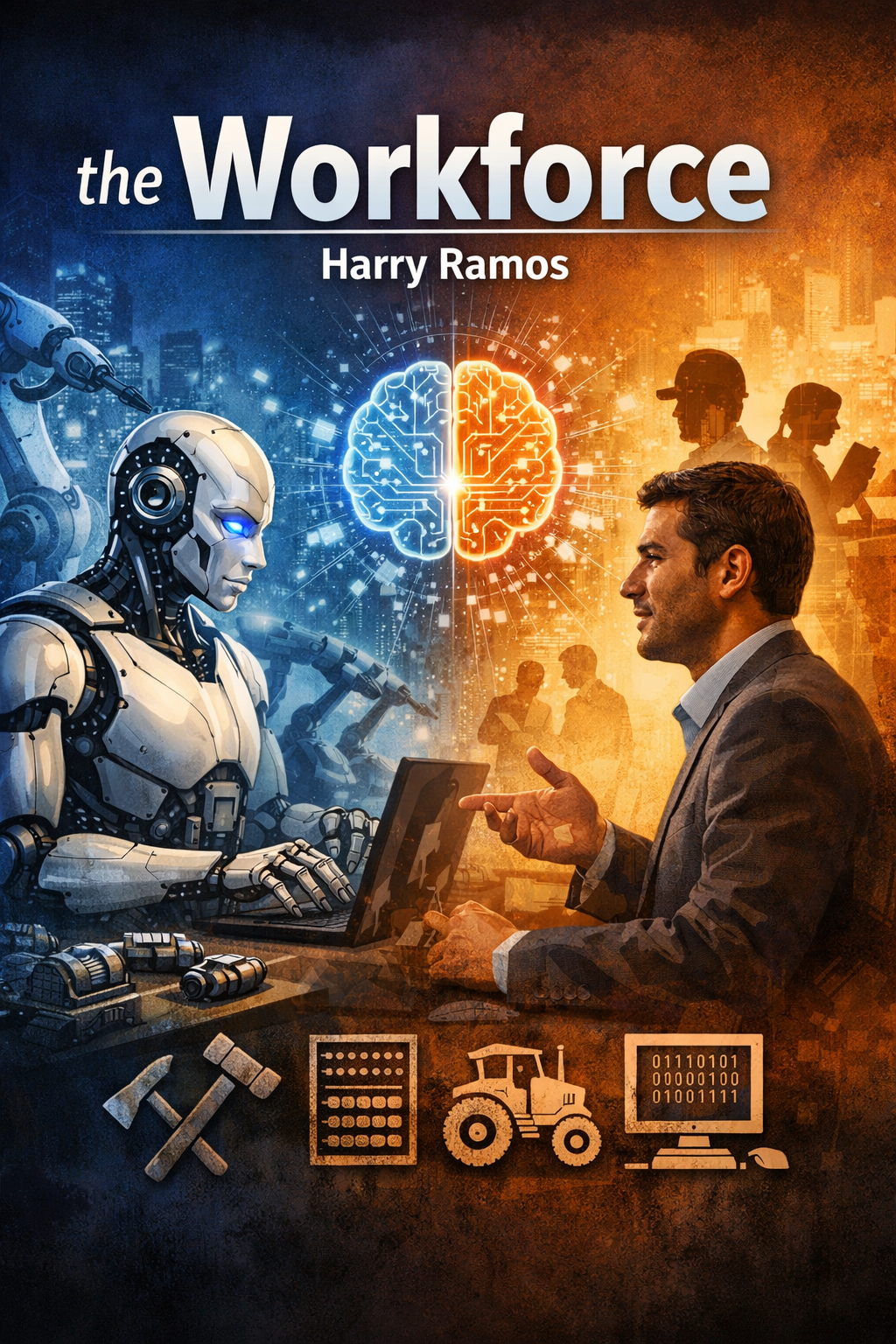
Last week, I was having a conversation with a good friend who was lamenting how AI was going to take away jobs. While uncertainty may be fair, these categorical blanket statements are contributing to this fear and hysteria surrounding Artificial Intelligence.
In the middle of his rant, he stopped and stared at me.
“You disagree? Of course you do. You're the CEO of an AI company—greater production with no negative impact on society…”
With that, I realized this might make for a good article.
Putting aside the Terminator paradigm, although if an AI world domination event were to happen, I tend to lean more toward an Ultron or hacker arc than Terminator-style reality—I believe the issue is not an overestimation of AI’s potential capabilities but rather a misunderstanding of a key component of the tool as a… tool.
The truth is, as I relayed to my friend, the impact of AI will be more akin to introduction of adding machines in business than to AI drone bots replacing workers. Greater efficiency does not mean fewer work hours, it simply represents a reallocation of mental joules, not the creation of free time or replacement of workforce. After all, we still have accountants even after the invention of adding machines, and later, digital calculators.
Currently, most Americans think of Large Language Models (LLM) when they think AI. But, with that in mind, which of the popular LLMs work without a prompt from a human? Even setting up automated systems, what automation runs without a human scheduling or configuring the process? What LLM response can be truly interpreted without human judgement?
All disruptive technologies shape the world and workforce. The hammer and chisel, the wheel, the plow, the automobile, the computer, the internet—and now this generation of AI. For the record, procedural AI has been around for decades.
There is no question that current AI systems are powerful pattern recognition engines—on steroids. They can be trained on enormous datasets and converge on patterns that an individual might miss or take years to discover.
These wondrous neural networks are incredible tools and can be trained on, and have access to a vast wealth of knowledge. Yet knowledge itself does not possess will. Even the great Library of Alexandria, containing the knowledge of civilizations, was powerless to defend itself. In much the same way, AI systems remain dependent on human direction and human purpose.
Because of this, I believe they will never replace the human mind—or God’s creation, man.
